
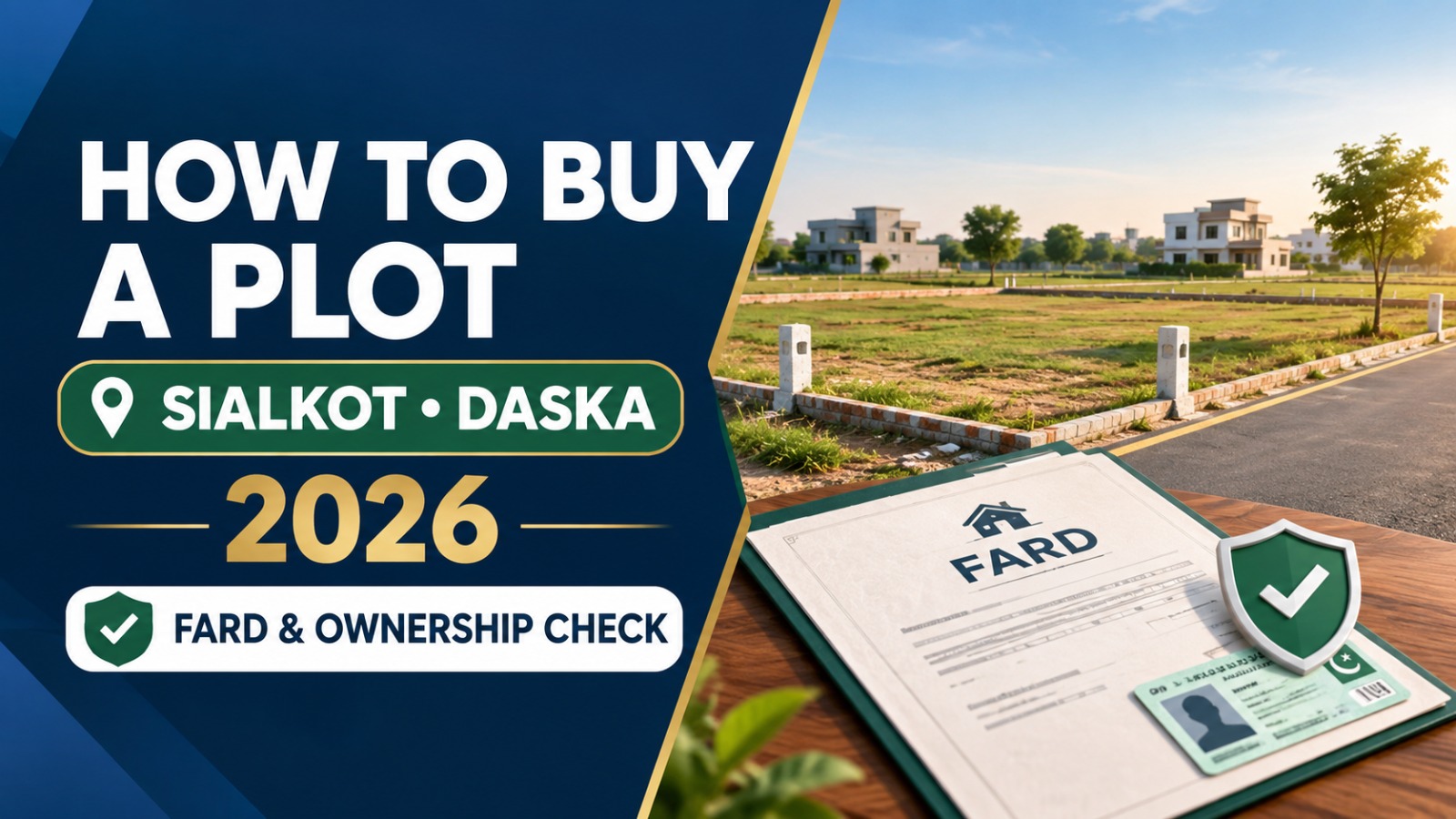
How to Buy a Plot in Sialkot & Daska (2026 Guide)
By Engr. Ahmad Sheraz Cheema, Warasat Real Estate Agency
Short answer: To buy a plot in Sialkot or Daska in 2026, get a fresh fard of the land from the Punjab Land Records Authority (PLRA), match it with the seller's CNIC, confirm there is no dispute, then register the sale deed through PLRA e-registration. The buyer pays advance tax under Section 236K, the seller pays under 236C, and everyone appears before the Sub-Registrar for biometric verification.
Key facts (2026)
- Fard first: never pay a token amount before you see a fresh fard.
- Buyer tax (236K): flat 1.25% for active taxpayers (ATL filers) from 1 July 2026.
- Seller tax (236C): flat 2.75% for active taxpayers.
- Section 7E: deemed income tax on property was omitted by the Finance Act 2026.
- New process: from 26 August 2026 the FBR challan for Punjab registries is generated inside the PLRA e-registration portal.
- Non-filers pay much higher advance tax, so check ATL status before fixing the price.
What is a fard and why does it matter?
A fard (fard-e-malkiat) is the official record-of-rights extract that shows the owner's name, share, area and the khewat, khatuni and khasra numbers of a piece of land. In Punjab you can get it from an Arazi Record Centre (ARC), an Arazi Moawin centre, or the PLRA online fard service. A verification fard checks ownership, while a registry fard is used for buying and selling. Always ask for a fresh copy, not a photocopy the seller already holds.
Step-by-step: buying a plot in Sialkot or Daska
- Verify the seller. Match the seller's CNIC with the name, share and area on the fard, letter for letter.
- Read the fard properly. Check the mutation (intiqal) history and look for mortgages, court orders or a recent transfer that does not match the seller's story.
- Match the plot on the ground. Confirm that the khasra number and area on the record match the actual plot. A mismatch is a classic fraud sign.
- Check land status. For plots on roads like Sambrial-Daska Road, confirm the land-use status. For plots inside a housing scheme, confirm the scheme is approved.
- Confirm the value. Taxes are charged on the higher of the declared price and the official FBR/DC value.
- Check ATL status of both buyer and seller.
- Open the e-registration case on the PLRA portal. Enter buyer, seller, witness and property details, generate the challan there, and pay stamp duty and fees online.
- Visit the Sub-Registrar. Buyer, seller and witnesses bring original CNICs for statements and biometrics.
- Collect the registered deed and follow up on mutation. Request a fresh fard in your name as the final proof.
Taxes and fees at a glance (filers)
- Section 236K advance tax (paid by buyer): 1.25%
- Section 236C advance tax (paid by seller): 2.75%
- Section 7E deemed income tax: omitted from 1 July 2026
- Stamp duty, CVT and registration fee (provincial): check the PLRA fee calculator for the exact amount
236K and 236C are adjustable advance taxes. Example (illustrative): on a plot valued at Rs 50 lakh, a filer buyer pays Rs 62,500 (1.25%) and a filer seller pays Rs 137,500 (2.75%), before stamp duty and other provincial charges.
Common mistakes buyers make
- Paying a large advance on a stamp-paper agreement without checking the fard.
- Trusting an old photocopy of a fard.
- Buying from someone whose name does not match the record.
- Under-declaring the price. It does not reduce tax because the official value applies.
- Not following up on mutation after registration.
Buying in Sialkot, Daska and Bhopalwala with Warasat
Warasat Real Estate Agency verifies the fard and mutation history and guides buyers through PLRA e-registration before any payment. See our current plots and houses or contact us on +92 301 6667697 for a document check.
FAQs
How can I check a fard online in Punjab?
Use the "Fard Online" service on the PLRA Punjab Zameen website. Enter the property details and download the fard as a PDF, or visit your nearest Arazi Record Centre with your original CNIC.
What documents are needed to get a fard?
Your original CNIC and property details such as khewat, khasra or registry number. A representative needs a verified power of attorney.
What is the buyer's tax on property in Pakistan in 2026-27?
Active taxpayers pay a flat 1.25% under Section 236K from 1 July 2026. Non-filers pay a much higher rate.
What is the seller's tax on property in 2026-27?
Active taxpayers pay a flat 2.75% under Section 236C. Non-filers pay significantly more.
Where is the FBR challan generated for Punjab property registration now?
From 26 August 2026, inside the PLRA e-registration portal, not separately on the FBR website.
Is Section 7E tax still applicable?
No. The Finance Act 2026 omitted Section 7E.
Is a stamp-paper agreement enough to buy a plot?
No. A registered sale deed is the safe route, and mutation depends on registration.
Disclaimer: General information, not legal or tax advice. Rates and procedures change; confirm with PLRA, FBR or a lawyer before transacting.
Sources: PLRA Punjab Zameen (Fard information); KPMG Taseer Hadi, "A Brief of Finance Act 2026"; FBR Budget 2026-27 Salient Features; PLRA e-registration portal.